SEO and social media work together as a unified visibility system: SEO helps you understand what people search for, while social media helps you distribute content, strengthen brand recognition, and drive traffic to your site.
Search behavior is changing fast. As of 2024, over 5 billion people use social media globally. And here's what matters: 46% of Gen Z now use social primarily for search, not Google. When someone in this generation wants to find a restaurant, they open TikTok or Instagram – not Google Maps.
Social signals, such as likes and shares, don't directly affect Google rankings. But they drive indirect benefits that do: referral traffic, online mentions, backlinks, and branded search volume. According to Social Insider, 62% of Gen Z use TikTok, and 67% use Instagram to find businesses and products.
What Is Social Media SEO?
SEO for social media marketing is the process of optimizing your social profiles and posts, so your content is easier to find – both within social platforms (TikTok, Instagram, LinkedIn search bars) and in traditional search engines like Google.
Look at a real example. Search "Curlsmith" on Google. The brand's Instagram, YouTube, and Facebook pages appear on the first page. That's social media for SEO in action – optimized profiles showing up for branded searches.
How does this differ from traditional SEO? Traditional SEO relies on long-form written content, backlinks, domain authority, and site speed. SEO on social media relies on visual content (images and videos), engagement metrics (likes, comments, shares), and referral traffic.
How SEO and Social Media Work Together
Using social media for SEO doesn't directly affect Google rankings – but it strengthens your SEO through increased traffic, brand awareness, online mentions, backlinks, and branded search volume.
Here's how the technique actually works:
- You publish valuable content on social media.
- People engage with it.
- Some visit your website.
- Others mention your brand in blog posts, articles, forums.
- A few links back to your site.
- Then more people start searching for your brand name on Google.
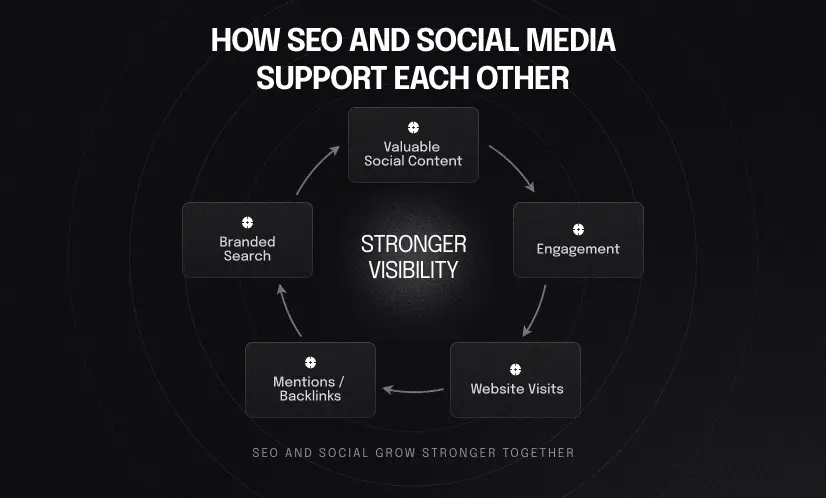
And so the cycle builds momentum.
Social profiles also rank in the branded Search Engine Results Page. When someone searches your company name, your Facebook page, LinkedIn profile, Instagram account, and YouTube channel often appear on page one. You control what shows up by optimizing those profiles – consistent keywords, clear descriptions, updated links.
The thing is, these indirect benefits add up faster than most brands realize.
Why Social Media Matters for Search Visibility
The numbers don't lie. 62% of Gen Z use TikTok and 67% use Instagram to find businesses and products. 40% of people aged 18-24 use TikTok or Instagram instead of Google Maps when looking for restaurants. 21% of Gen Z start brand searches on social media, not search engines.
Compare that to overall search behavior: 88% of people use traditional search engines, 31% use social media, and 12% use AI chatbots like ChatGPT. Social media and search engine optimization don’t replace each other for everyone. But it's becoming the primary channel for younger generations (and probably will be for everyone else soon).
Platform-specific discovery breaks down like this: TikTok and Instagram dominate for Gen Z. YouTube works across all age groups. LinkedIn is the go-to for B2B research. Pinterest drives product discovery for home, fashion, lifestyle categories.
If your audience searches on TikTok but your brand only shows up on Google? You're basically invisible to them.
10 SEO and Social Media Strategies to Grow Your Brand
These 10 strategies connect search intent, social content, and measurable performance. Use them together – build a unified system where every post serves both discovery and engagement.
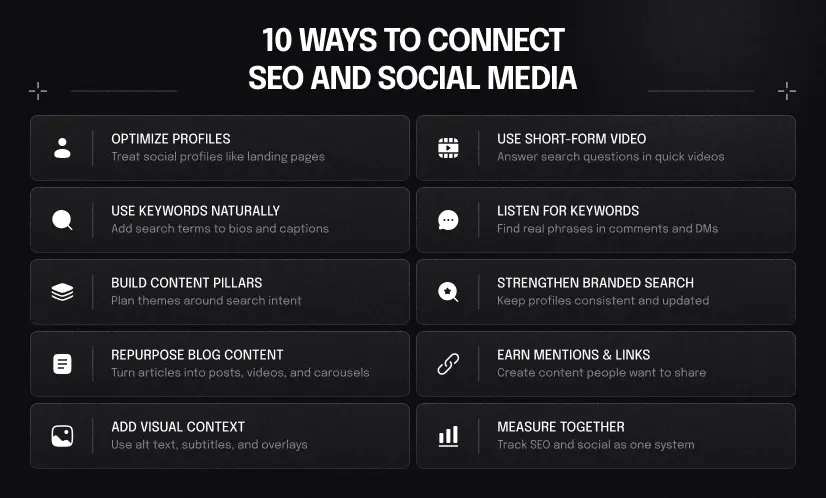
1. Optimize Social Profiles Like Landing Pages
Treat every social profile as a landing page (because that's what it is).
Use a clear bio with relevant keywords. Add your website link. Maintain consistent brand name and visuals. Include positioning that explains what you actually do – not some vague "we help businesses grow" nonsense.
Start with your username and handle. Use your brand name, and if space allows, add a keyword. Next, the name field – this is where you can include niche-relevant keywords naturally. For example: "John Smith | B2B SEO Consultant" or "VA Promo | Social Media Marketing SEO Agency."
Your bio should provide context, keywords, and a value proposition in 150–200 characters. Be specific: "B2B SaaS SEO services for tech companies scaling organic traffic."
Add your website link and keep it consistent and trackable using UTM parameters. Include your location if you serve local markets – helps with local search visibility on both social platforms and Google.
Use professional, recognizable profile and cover photos. Pursue verification badges where available: Meta Verified, Twitter Blue, LinkedIn verification.
2. Use Keywords Naturally in Captions and Bios
Integrate search phrases into captions, video titles, descriptions, and bios the way real people talk – avoid keyword stuffing by focusing on one primary keyword per post and using natural variations.
Place your keyword in the first 1–2 sentences of your caption. Platform algorithms prioritize early text when determining what your post is about. For video titles, lead with the keyword or the question users are searching for.
Don't repeat the same keyword five times in one caption. That's keyword stuffing, and it hurts engagement. Instead, use LSI keywords – related terms that mean the same thing. If your main keyword is "social media & SEO," also use "social search optimization," "platform optimization," and "social visibility."
3. Build Content Pillars Around Search Intent
Create 3-5 content themes based on what your audience searches for: how-to guides, comparisons, FAQs, case studies, pain point solutions, and industry trends.
Content pillars are keyword clusters organized by topic. Each pillar addresses a specific type of search intent: informational (learning something new), navigational (finding a specific brand or page), commercial (comparing options), or transactional (ready to buy).
For example, if you run an SEO agency, one pillar might be "SEO Basics." Topics under that pillar: what is SEO in social media, how to rank on Google, beginner mistakes, and essential tools. Another pillar: "Tool Comparisons" – Semrush vs. Ahrefs, best keyword research tools, free vs. paid options.
4. Turn Blog Content Into Social Posts
Repurpose your SEO-optimized blog articles into carousels, short videos, LinkedIn posts, Threads, Reels, and YouTube Shorts to maximize reach and reinforce your content pillars.
One blog post can become 10+ social assets. Turn a listicle into a carousel. Break down a tutorial into a 60-second video. Pull out key quotes for graphics. Answer the blog's main question in a TikTok or Reel.
Use the same keywords in social media that you have in your blog. This reinforces the topic across channels and helps both rank for the same search terms. Link back to the full article in your bio or in the comments.
For video formats, answer the blog's main question in 30–60 seconds. Use the answer-first approach: tell viewers what they'll learn in the first 3 seconds, then explain. For carousels, break down your "10 tips" blog into a slide-by-slide visual breakdown.
Cross-platform distribution works like this: create one short video. Post it on TikTok, Instagram Reels, YouTube Shorts, and LinkedIn with slight edits for each platform's format and audience.
5. Add Alt Text, Subtitles, and Visual Context
Incorporate images and videos with descriptive alt text, accurate subtitles, on-screen text overlays, and keyword-rich file names. Accessibility and searchability both matter (and they overlap more than most people realize).
Alt text describes what's in an image for visually impaired users and search engine optimization social media. Include your keyword naturally. For example: "B2B social SEO marketing team analyzing SEO dashboard" instead of "team meeting."
Subtitles and captions aren't just for accessibility – they also help algorithms understand your video content. 85% of Facebook videos are watched without sound, so subtitles improve watch time and comprehension.
Add overlay text to your videos. On-screen text increases engagement and helps viewers understand your point even without audio. Platforms like TikTok and Instagram prioritize videos with clear visual context.
Rename your files before uploading. Use descriptive, keyword-rich names like "social-media-seo-strategy.jpg" instead of "IMG_1234.jpg." Some platforms actually read file names as metadata.
For YouTube and LinkedIn, add full transcripts. These help with searchability and let users skim content before watching.
6. Use Short-Form Video for Search Discovery
Create short videos (15–90 seconds) that answer specific user questions, use an answer-first hook, include spoken keywords, and add captions to increase discoverability on TikTok, Instagram, and YouTube.
Platforms are prioritizing short-form video: TikTok, Instagram Reels, YouTube Shorts, and LinkedIn video all favor this format. Videos that answer specific questions perform best in search and discovery feeds.
Use an answer-first format. In the first 3 seconds, tell viewers exactly what they'll learn: "Here's how to optimize for social SEO." Then explain the steps. Don't waste time with long intros.
Speak your keywords out loud. Platform algorithms use auto-generated captions and transcripts to understand what your video is about. If you're targeting "social media in SEO," say that phrase in the video.
Use question-based titles. "What is social media SEO?" performs better than "Social media tips." Questions match how users search.
Pin your best educational or evergreen videos to your profile. This keeps them discoverable long after you post them.
7. Use Social Listening for Keyword Ideas
Find real search phrases your audience uses by monitoring comments, DMs, customer reviews, TikTok search suggestions, Reddit threads, and competitor discussions.
Look in the comment sections. What questions do people ask? Check your DMs. What problems do they bring up repeatedly? Read Facebook group discussions and Reddit threads in your niche. Browse Quora questions related to your industry.
Use TikTok's autocomplete feature. Start typing a keyword in the search bar and see what suggestions appear. Those are real queries people are searching for.
These tools are useful in this case:
- Hootsuite Listening
- Semrush Keyword Magic Tool
- Ahrefs Keyword Generator
But don't ignore native platform search bars. They show you real-time trends and questions.
8. Strengthen Branded Search With Social Profiles
Make your social profiles a strategic part of your branded SERP by keeping descriptions updated, linking to your website, showcasing case studies, and maintaining consistent visuals across platforms.
When someone searches your brand name on Google, what appears? Go check right now. Your Facebook page, LinkedIn profile, Instagram account, YouTube channel, and Twitter profile should all rank on the first page.
Pin important posts to the top of your profiles: case studies, client testimonials, and key service offerings. These show up when people visit your profile from search results.
Update your links regularly. Outdated or broken links hurt credibility. Make sure every profile links to your current website, not an old domain or a 404 page.
9. Encourage Sharing, Mentions, and Link Opportunities
Publish useful, shareable content like mini-guides, original data, industry insights, and case studies that naturally earn shares, mentions, and backlinks from other sites.
Shareable content formats include step-by-step guides, cheat sheets, templates, infographics, data visualizations, and trend reports. These provide immediate effect and are easy to reference or link to.
Ask questions in your posts to leverage replies. Social signals like comments and shares boost your visibility in platform algorithms. Tag relevant brands or people when appropriate – but don't spam.
Make sharing easy. Include clear CTAs like "Share this with your team" or "Tag someone who needs to see this." The easier you make it, the more shares you'll get.
Track your mentions using Google Alerts for your brand name or tools like Mention.com. When someone mentions you without linking, reach out and ask if they'd consider adding a link. According to HubSpot, 25% of social network users purchased on social platforms within three months – these mentions and shares drive real business outcomes.
10. Measure Search and Social Performance Together
Track referral traffic from social to website, branded search volume, clicks from social profiles, assisted conversions, engagement by content pillar, and leads/sales attributed to social channels.
Don't measure SEO and social media in silos. They influence each other, so track them as one system. Key metrics include referral traffic (how many visitors come from social to your site), branded search trends (are more people searching your brand name?), social profile clicks (how many people click your bio link?), and assisted conversions (did social play a role in the customer journey?).
Evaluate content pillar performance. Which themes drive the most engagement on social? Which drives the most traffic to your website? Which converts into leads or sales? This tells you where to focus your efforts.
Common Mistakes in SEO Social Media Marketing
Most brands make these mistakes when integrating social media and SEO:
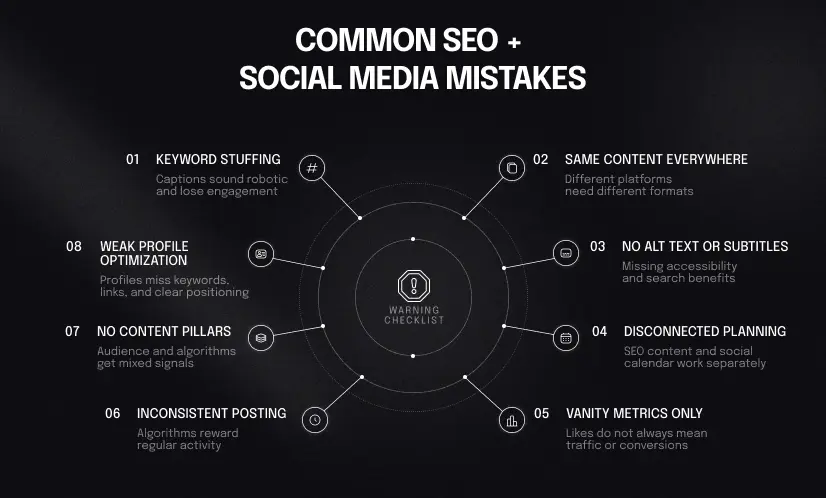
- Keyword stuffing in captions sounds robotic and hurts engagement rather than helping it.
- Posting identical content across all used platforms – different audiences need different formats and messaging.
- Ignoring alt text and subtitles – missing both accessibility requirements and search benefits.
- No connection between SEO content plan and social calendar – teams work in silos, missing cross-channel relationship.
- Focusing only on vanity metrics – likes and followers don't matter if they don't drive traffic or conversions.
- Inconsistent posting – algorithms on every platform reward consistent activity.
- No clear content pillars – confuses both your audience and search algorithms.
- Not optimizing profiles – this is the easiest win, and most brands skip it.
How VA Promo Combines SEO and Social Media Strategy
VA PROMO connects SEO insights, social media content, paid and organic distribution, analytics, and optimization into one unified strategy tailored to your business goals.
The approach starts with SEO keyword research, which informs social content themes. Social listening reveals new keyword opportunities that feed back into the SEO strategy. Blog articles are repurposed into social assets: videos, carousels, LinkedIn posts, TikToks.
VA Promo's niche focus means working with clients in specific industries – B2B SaaS, real estate, healthcare, Web3 – to develop deeper expertise and deliver better results. For brands looking for agencies that understand both channels, exploring options among the best boutique digital marketing agencies can help identify partners with integrated approaches.
The team also offers dedicated social media marketing services designed to work alongside SEO efforts, ensuring content is optimized for discovery, engagement, and conversion across all platforms.
Final Thoughts
SEO shows you what people are searching for; social media helps you reach them faster, test ideas, and strengthen your brand where they already spend their time.
Search behavior is changing. Your audience doesn't only use Google anymore. They search on TikTok for tutorials, Instagram for product reviews, YouTube for deep dives, LinkedIn for B2B solutions, and Pinterest for inspiration. You need to be visible where they actually search – not just where you assume they search.
Integration is the key. Don't treat SEO and social media marketing as separate channels, teams, or goals. Build content pillars that work across both. Use keyword research to inform social content. Use social listening to find new keywords for SEO.
.png)